
Every atom carries a dual legacy: the boundless curiosity of human inquiry and the catastrophic weight of its ultimate realization. In the latest edition of the Letter to Morisot (『モリゾへの手紙』) cycle, the visual poem Atom (原子) is translated into classical vertical Japanese typography (縦書き – Tategaki), bringing modern atomic history into direct dialogue with ancient Buddhist ontology.
1. Between Radium and Emptiness (Śūnyatā)
The poem traces its roots to a fundamental question of matter. In the late nineteenth and early twentieth centuries, Polish-born scientist Maria Skłodowska-Curie isolated radium (rad), proving that physical matter is packed with tremendous kinetic potential. Science revealed that matter is not inert, solid, or immutable.
Long before modern particle physics, Buddhist philosophy arrived at a parallel realization through the concept of the paramāṇu – the smallest indivisible unit of physical phenomena. In Buddhist thought, the paramāṇu does not exist as an independent solid object. It arises and vanishes within an instant, suspended in emptiness (Śūnyatā), sustained only by the dynamic interplay of the four primary elements (mahābhūta):
- Earth (Pṛthvī): Solidity and cohesion
- Water (Āpas): Fluidity and binding
- Fire (Tejas): Radiation, heat, and energy
- Wind (Vāyu): Continuous motion and oscillation
When matter is split by human hands, this elemental balance is violently disrupted. The historical memory of Hiroshima and Nagasaki transformed theoretical physics into profound existential grief. Atom (原子) approaches this historical fracture not with political rhetoric, but through contemplative art – transforming atomic energy from a weapon of destruction into an instrument of reflection, memory, and healing.
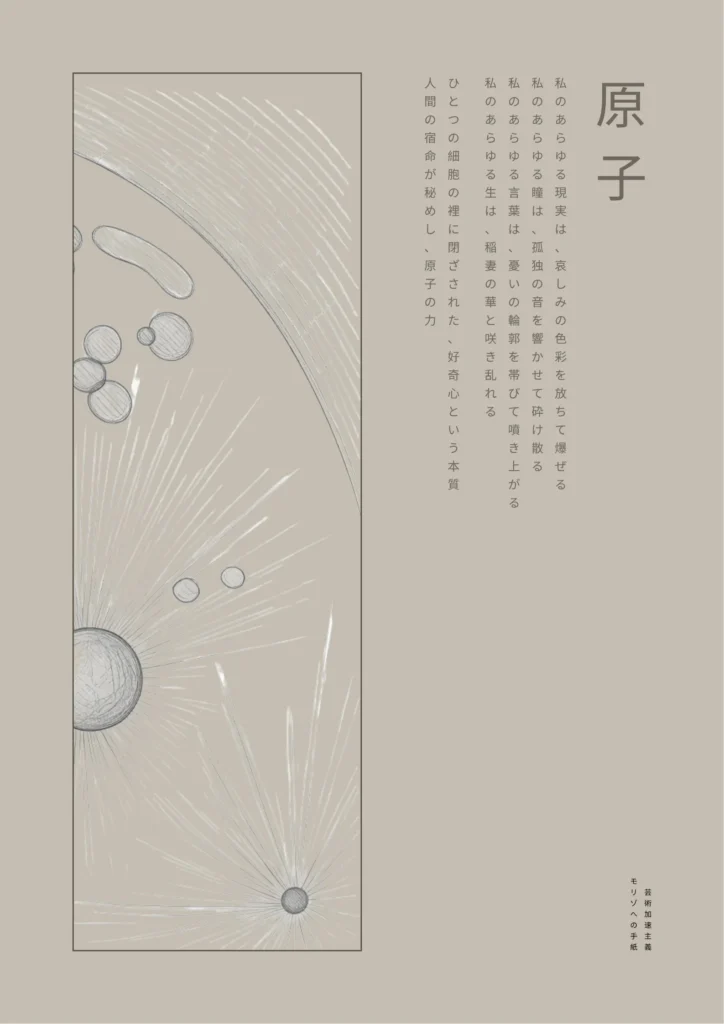

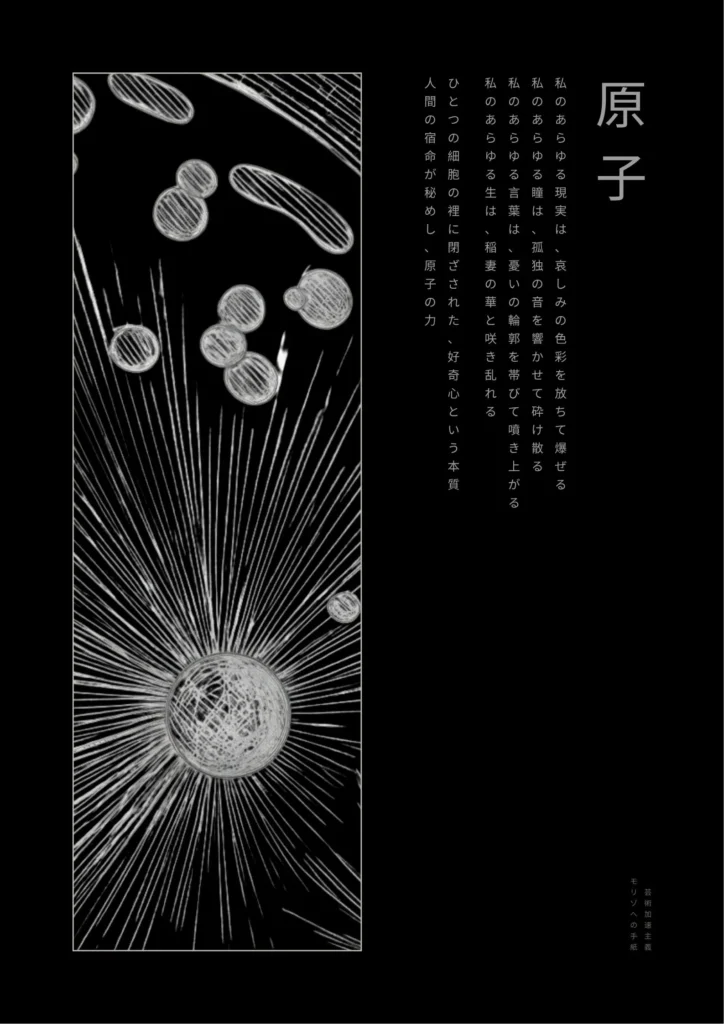
2. The Vertical Architecture of Japanese Mincho
原子

私のあらゆる現実は、哀しみの色彩を放ちて爆ぜる
私のあらゆる瞳は、孤独の音を響かせて砕け散る
私のあらゆる言葉は、憂いの輪郭を帯びて噴き上がる
私のあらゆる生は、稲妻の華と咲き乱れる

ひとつの細胞の裡に閉ざされた、好奇心という本質
人間の宿命が秘めし、原子の力
English Original:
All my realities will explode with colours of sorrow
All my eyes will blow up with sounds of solitude
All my words will erupt with shapes of sadness
All my lives will blossom with flowers of lightning
The nature of curiosity closed in just a cell
The atomic power of human fate
Transposing the English text into Japanese required more than linguistic translation; it demanded a formal shift in space and cadence. Typeset in an archival Mincho (明朝体) typeface, the vertical arrangement (Tategaki) reflects the literary rhythm of twentieth-century Japanese writing.
The downward visual flow of the text creates a deliberate counter-tension against the upward-radiating graphite linework of the drawing. As the eye travels down through lines of sorrow, solitude, and lightning, the illustration surges upward from the core, enacting the burst of energy described in the verses.
3. Form and Void: The Alabaster & Obsidian Diptych
To express the philosophical tension between emergence and emptiness, the broadside exists in two complementary colorways:
- The Alabaster Edition: Rendered on a warm cream ground, evoking the texture of raw washi paper and natural light. It represents the visible world of form (Rūpa), organic biology, and quiet presence.
- The Obsidian Edition: Set against a deep black void, with luminous white linework and typography emerging from the dark. It represents the unmanifest void (Śūnyatā) and interstellar space.
Drawing inspiration from the Japanese tradition of tsuifuku (対幅) – paired hanging scrolls that achieve perfect balance through contrasting motifs – the Alabaster and Obsidian prints are designed to function either as independent statements or as a unified two-panel diptych on the gallery wall.

Exhibition & Studio Edition
Atom (原子) — Japanese Kanji Archival Broadside A2
Printed on 100% cotton Hahnemühle® William Turner mould-made paper (190 g/m²). Available in individual Alabaster and Obsidian editions, or as a curated two-panel diptych set.
Explore the Editions →4. Archival Craftsmanship
Printed in limited studio runs at A2 dimensions, each broadside is executed on Hahnemühle® William Turner 190 g/m² mould-made paper:
- 100% Cotton Rag: Pure cotton fibers provide archival longevity and an authentic tactile weight.
- Genuine Felt Texture: The subtle, matte surface absorbs fine pigment inks without reflection, preserving the delicate graphite pencil marks and precise Mincho strokes.
- Movement Mark: Bearing the dual imprint of
芸術加速主義(art/acc) andモリゾへの手紙(Letter to Morisot), anchoring each print within an ongoing exploration of poetic acceleration, philosophy, and material form.
Atom (原子) stands as a meditation on the smallest scale of reality—where human curiosity, scientific destiny, and cosmic impermanence converge.
art/acc
Beata
Acquire the Broadside Edition
A2 Archival Pigment Giclée | Hahnemühle® William Turner 190 g/m² | art/acc (2026)
No responses yet